
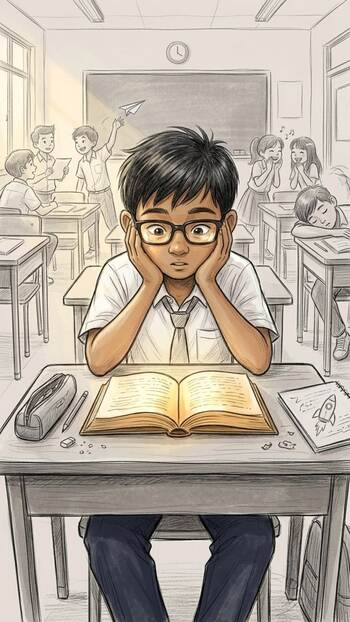
Early childhood and adolescence is all too often a time of conflict for youngsters who pit themselves against authority whether it be at school or in the home.
Why do children have conflict with authority? The answer to this is that figures of authority often project a negative image to children. They appear to be fearsome, domineering and authoritative. Along with harsh disciplinary measures, this negative image is intensified leading to insecurity and poor self-esteem which, in turn, gives rise to frustration and dissonance with authority.
In what way do they show their frustration? Their frustration is often acted out in the form of aggression by defiance, verbal and physical attacks, opposition to a suggested activity, disrupted behaviour, cheating, lying, stealing and rowdyism in groups.
Who are the authority figures in a child’s life? Objects in authority can range from significant adults and peers to media and situations. Some examples are: adults – parents, teachers, older siblings, police; peers – friends, gangs in school or in the neighbourhood; media – the internet in all its facets, situations – divorce, death of a significant adult, changes in environment, birth of a new sibling.
What aspect of a child’s development is affected when in conflict? When in conflict with authority, the child’s social and emotional aspects and development are affected. There is a basic motivational drive in each individual which strives to achieve a sense of belonging.
There are several reasons why a child’s needs may not be met: autocratic leadership which is dictatorial and places high expectations on the child emphasising punishment; the laissez-faire style, on the other hand, makes no demand on the child therefore the child is confused in decision-making and has no expectancy of rewards and punishment; faulty role modelling by aggressive parents; prejudicial attitudes by authority figures; inconsistent disciplining patterns; and poor development of values or morality.
Which disciplining pattern works best for children? A democratic disciplining pattern works best for children where the approach is on firmness with dignity. This pattern does not thwart the needs of esteem and belonging thereby providing a climate of positive discipline.
What is positive discipline? Positive discipline focuses on clear definition of rules and the use of rewards. It conveys to the child a realistic understanding of what is expected of him or her, the limits of behaviour and the possible consequences of not conforming. Positive discipline emphasises the involvement of children in deciding the rules of behaviour and the logical consequences for keeping or not keeping their agreements. It is essential to keep in mind that one should not humiliate the child. The focus is on the solutions rather than the consequences. Above all, positive discipline makes sure that the message of unconditional love and respect gets through to the child even when discipline is being enforced.
What is the role of punishment? Punishment plays a major role in disciplining the child. However, the emphasis is on the judicious use of punishment in the form of time-out from attention or withdrawal of privileges. This kind of usage of punishment teaches a child the desired and undesired behaviour. Punishment and reward go hand in hand. Desirable behaviour fetches a reward and undesirable behaviour results in the absence of rewards, time-out or withdrawal of privileges.
How can you prevent a conflict from erupting? The basic step is understanding a child’s motivational aspects, that is his or her need to BELONG. Therefore, it is important to enforce a disciplining pattern which will not pose a threat to this need to belong. Avoiding ineffective leadership, making effective rules of behaviour and teaching appropriate behaviour by rewards. Judicious use of punishment and good role-modelling are some of the ways of preventing conflict with authority.
Encouraging and motivating the child while rewarding his or her actions rather than criticising them seems to be the key to solving problems. It is essential to involve the child in the process of making the rules as he or she would realise the consequences of violating them. Children often abide by these decisions especially when parents are aware that humiliation and criticism are not the key to help children respect rules.




Parenting is an ongoing lesson. There is no such thing as perfect parenting. Each experience leads to a choice between growth and repeated errors. Discrimination becomes key to making the right choice. But underneath it all is unconditional love which includes forgiveness of oneself and the offspring. The most important lesson for a parent to remember is that he/she was once a child too. From that a parent can gage in general how a child responds. The question of karmic results of any action or thinking is an important one to remember and share with an offspring.A slow but regular exposure to prayer and gratitude to God are important for a child. Discipline automatically sets in when humility and forgiveness are exercised by the parent.The child notices it all and in accordance with Divine help all turns out the way it is meant to. Everyone does the best they know how at a given moment in a given context. But there’s always room to grow because Infinite Potentiality is a gift from God to all human beings.